Woodland Creek Soay Rams

Woodland Creek Soay Rams
Soay Sheep Ram Assortment

Friday, March 26, 2010

Lamb status at Woodland Creek

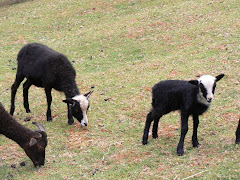
No new lambs today but with nice weather I sat and watched the 5 new lambs cavort. Here are a few photos from today. First, three separate and distinct color phases of Soay lambs. Left, a dark-self with white spotting, center, a light-wild with white spotting, and last, a "common" dark-wild, also with white spotting. Get the idea that I have lots of white spotting in my flock?
Bandit - r, Santa Fe - r, and Pistol - e
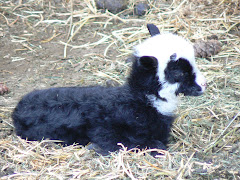
Yesterday's little dark-self ram has now been named - Dakotah. Here he is basking in the sun. You can surely see why I just love the shiny black of fresh new black lambs! Note his mother's light-self (uniform brown) leg in the background. Dakotah has to be Aa/Aa, BB/Bb, SS/S?.
Woodland Creek Dakotah '10 - ram
Our development of light phase in the NA Soays has consisted of selecting those that have less and less pheomelanin (the reddish pigment so prevalent in many PNW NA Soays). Woodland Creek Santa Fe has the least "pheomelanin cast" of any lambs we've had here at Woodland Creek. Bandit in the background. What a contrast.
Woodland Creek Santa Fe '10 -ram
Little Santa Fe has the oddest little face.
Woodland Creek Santa Fe '10 -ram
And finally, since I touted the "4-color" rams shot a few days ago, with some fresh grass as a lure, it was pretty easy to capture a single photo showing all four color phases in ewes. Below, in the foreground from left to right is: dark-self, dark-wild, light-self, and finally light-wild. You can see from my ewe flock that I like a mix of colors and coat patterns!
Lambing count stands at 5 (live) and more on the way within days, I would say.

Thursday, March 25, 2010

And now for something completely different

Another breeding group we have, which I briefly described earlier, is the self-colored light phase, aka SCLP or self-light. Before I obtained the two that are still know to be alive in North America, I was working toward producing them on my own.
One way to do this is to assure that each lamb has one copy of both recessive genes, and this is done by mating a self-black with a light-wild (presuming that the black does NOT have a hidden copy of light, and that the wild does NOT have a hidden copy of self). I did this with a number of pairings for the 2008 lambing season, and obtained 4 ewes and 2 rams with the genotype A+/Aa, BB/Bb. (Some were also homozygous for white spotting as well, but let's keep this simple for now).
When I unexpectedly obtained the self-light ewe Blue Mountain Cocoa last summer, my best bet for a sire was to use my "half-way" SCLP ram, Woodland Creek Sequoyah, with a genotype as described above (and Ss/Ss, so a small white poll spot too, just in case you wondered.)
So here is Cocoa, the SCLP.
Blue Mountain Cocoa '08
and the sire,
Woodland Creek Sequoyah
So what were the possibilities and odds? With the dam genotype of Aa/Aa, Bb/Bb, she had to contribute Aa and Bb, both recessive. The sire, however, could have contributed A+, Aa and BB or Bb. So there was an equal 25% chance of any one of the four basic coat patterns - dark-wild, light-wild, dark-self, or light-self (shown in the order of more to less common). Drum roll... the result was...
Blue Mountain Cocoa and her 2010 ram lamb
I had observed the breeding of Cocoa and knew that if successful she should be due today (+/- a day or two), and she was acting funny yesterday evening. When I searched for her at 4 AM, I found her with this little ram lamb. For some reason I find the sight of a solid black lamb with a "chocolate" ewe to be very odd. So this little ram (not yet named) will has a known genotype - he has to be Aa/Aa, BB/Bb, SS/Ss (the last because the sire Seqoyah has a small white poll spot, but the new ram lamb does not). He would have pretty decent odds for use in a breeding program to produce more SCLP Soays.
Not to make too much of it, but I am pretty sure this is the first birth in North America of a self-black lamb to a self-light Soay!

Mystery solved - missing lamb found

Well, you had to know this was not going to have a good outcome, right? The dam, good ole Thumper, was looking pretty chipper and eagerly dove into the grass in the new pasture the day before yesterday. However, by the end of the day yesterday she was looking not-so-good. It finally dawned on me that the afterbirth that she was still carrying was not right. She should have passed the afterbirth within a few hours if she had lambed. She stayed up on the back hill by herself last night and when I checked on her at 4 AM this morning, she was a goner.

(Spoiler alert - if you don't like photos of dead lambs, you should stop reading now and go find something more pleasant).

I began to think that in fact, the lamb had never been born, and the protruding membranes were actually just the amniotic sac... so I had to know, and so performed a crude necropsy. Sure enough, poor old Thumper had a large ram lamb in her uterus, and it was turned completely sideways so that the back and shoulders were facing the cervix. There is no way the poor thing could have been born, nor even turned properly for a normal birth.

So, genetically, the lamb was of course a black-and-white, as the sire was Yosemite (same sire as Athena's lamb yesterday) and Thumper was our original B&W ewe. Since Athena was Thumper's daughter, the dead ram lamb was Athena's lambs "half-brother" as well as "half-uncle". The interesting part is the ram lamb's markings, shown below.

Thumper's 2010 ram lamb
If you look back to yesterday's post at the photo of Bandit, you will see that the markings are nearly identical. Oh, I'll save you the trouble. Here is Bandit, and his dam Athena, today.
WC Athena '08 and Bandit-r '10
Well, rest in peace good old Thumper. You had 10 or 11 lambs over 10 years and produced a lot of Black and Whites!
Thumper and some of her family in Apr-2006
(Thumper, her lambs Bunny, Kaya, and all their lambs Pepper, Obsidian and Kip)

Wednesday, March 24, 2010

Soay sheep lamb weights and owl lift capabilities

OK, so I'm an an analytical nerd. I did a quick google search on Soay sheep lamb weights and came up with the following article:


Predictors of early survival in Soay sheep: cohort-, maternal- and individual-level variation
Owen R Jones,* Michael J Crawley, Jill G Pilkington, and Josephine M Pemberton, Proc Biol Sci. 2005 December 22; 272(1581): 2619–2625. Copyright © 2005 The Royal Society
http://www.ncbi.nlm.nih.gov/pmc/articles/PMC1559978/

Their data set was the 1989 to 2002 surveys of Soay sheep on the island of Hirta in the St. Kildas, so it is "real" Soay sheep.

While not explicitly publishing lamb weights, they reported them in their analysis on survival factors. From their Figure 2a, shown here:


I extracted their data from the figure above and calculated a mean value for weights in pounds.
The weighted average lamb weight in the above set was 3.94 pounds. OK, call it 4.
Although the data reported was categorical rather than continuous, so no proper standard deviation can be calculated, from visual inspection above one can deduce that about 90 percent of the lambs were between 1.7 and 5.7 pounds - quite a large range.
So, if, as reported, the Great Horned Owl can lift 5.5 lbs, there is a fair probability that any given lamb would be small enough to be taken.
Sadly, it was noted in the birding sites about Great Horned Owls that, uniquely, frequently take skunks. Now just think of a white-spotted solid black Soay lamb. Looks a lot like a skunk in the early morning light....

A much better lambing result today

When I put my "black and white" Soay sheep breeding group together I noted that the ewe who lost her lamb yesterday (Thumper) was getting the ram's attention the day before her daughter, Athena. True to form, today Athena lambed. First, a photo of Athena, who is so far the most extensively white-spotted self-black NA Soay ewe I've produced, and seen in North America.
Woodland Creek Athena '08
She was mated with WC Yosemite, who was the second-most white-spotted NA Soay ram I've produced / seen. Here is his photo.
Woodland Creek Yosemite '08
Now based upon my theory of white spotting extension (increases with each generation when both parents express white spotting), I expected a pretty white-spotted lamb. When I went out at daybreak, sure enough Athena was in labor, and darned if she wasn't in the same spot, under a shed overhang, as her mother the previous morning. Given the disappearing lamb yesterday, I decided to move her along to the enclosed shed for lambing. She was in long labor (by my experience) - about 2 1/2 hours, and I started to get concerned. Finally a nose and two front feet showed, but Athena was getting pretty worn out, so (for better or worse) I did the James Herriott routine and helped out. Fortunately the little guy (a ram) was alive and so far seems to be doing fine. Presenting, Woodland Creek Bandit, a little ram.
Woodland Creek Bandit -r '10

Since it didn't seem like Athena (first time lambing) was getting the idea of being a mother, and her mother Thumper was pining for her loss, I put them all together to see if Thumper would adopt. Here is a 3-generation shot of Thumper, her 2008 lamb Athena, and Athena's '10 lamb Bandit.
Bandit-r '10, Athena '08, and Thumper '00
Thumper was over her loss and not interested, and eventually Athena got the idea and took to motherhood, so it seems things are on track for a good lambing.

Tuesday, March 23, 2010

Rare Soay sheep photo

In all my internet browsing for Soay sheep images, I have never seen this. In one photo (I swear - not manipulated!) all four Soay sheep coat patterns (overlooking for now white spotting). I realized that in my yearling ram pasture I had all four patterns, and what's more, they lined up nicely for a photograph.
Voila: All four coat color phases in Soay Sheep

(click on photo to enlarge)
From left to right: dark-wild, dark-self, light-wild, and then the very rare light-self. (Yes, there are two more dark-self rams in the back of the row - ruined the perfect photo).
Note that the second and third both also have white spotting - another breeding goal I have is to add extensive white spotting to these more rare genotypes.
And to Soay purists, I will acknowledge that the two with white spotting are not the best conformation ever seen. That's a problem with rare genotypes--one tends to keep them all to retain the genetics even if the conformations are not great. But succeeding generations should be able to recover the conformation.

Where oh where has my little lamb gone?

Here at Woodland Creek Farm we have had about 60 Soay lambs born since we started in 2005. But I have never had anything like this happen.
Yesterday we were pleased to see our first 2010 lamb born to our "light-wild" group. Since this lamb also has white spotting, he is what I call "double homozygous recessive" for two of the three main coat color genes in Soay sheep - light at the brown locus and white spotting. Here is a photo of the little guy.
Woodland Creek Santa Fe (Saratoga X Laramie)
This morning when I checked the ewes just before daybreak, I heard the unmistakable sound of a freshly-lambed ewe bleating mournfully as if it had lost it's new lamb. When I finally found her, it was our good old matriarch of the "black and white" line, Blue Mountain Thumper '00. Yes, after 10 years and many lambs, she was searching frantically for her newest lamb. She had afterbirth hanging out, so I assumed the new lamb(s) were somewhere around and began the search.
First, I could not identify the location where she had likely given birth - usually signified by a "nest" pawed out, and fresh amniotic fluids, etc. None was found in the area she was searching. I began searching all around the hay sheds, in the (now dry) creek bed, and eventually walked every inch of the entire pasture. There was simply no lamb(s) to be found, nor any clear evidence of where she had given birth.
After waiting a bit for more daylight, both Michelle and I went back out and searched all over the pastures --looking in every nook and cranny. There was simply no lamb to be found. Yet Thumper continued to plaintively call for her missing lamb.
I began to worry that a lamb was stuck -- as once before she had a second twin with forelegs turned back -- and I had to intervene to straighten them so she could expel the (by then dead) second lamb.
So after watching her closely for several hours, it was pretty clear she was no longer having contractions nor straining, yet seemed clearly distressed. So I played vet and caught her and did a manual exam and found no lamb present. But her clearly reduced girth suggested that she had clearly expelled significant weight.
So where did the lamb go?
It remains a mystery. I walked the fence line and all the electric on top and ground wire at the bottom was intact. I am (pretty) sure no coyote came inside to snatch the lamb. We have not seen bald eagles around for months, and besides it was before sunrise and pretty dark.
What could have happened? I am stumped. Poor old Thumper.